
Team
Meet the Advisory Group
Continually striving to better training for PDMs
Pamela Gilpin
Head of Player Development and Wellbeing at World Players
Emily Figueroa
Lead Player Development Manager
Professional Footballers Australia
Lynsey Williams
Head of Personal Development and Welfare
The PCA (England)
The PCA (England)
Justine Whipper
Managing Director
Justine Whipper Consulting
Latest news from the WPA
Receive our quarterly newsletter with updates from the Roar Room, CASES, #RightToOrganise and more!
Thank you!


Stay Connected
-
pgilpin@worldplayersassociation.com
-
+447871571248
Copyright © 2024
Working with coaches in the Daily Training Environment (DTE)
When engaging with coaches within the team environment, consider the following to foster a positive working relationship;
- Learn the dynamics within your environment, know when to be present and when to step back
- Tailor your interventions based on the training block, be prepared to be flexible and adjust based on the teams current status
- Identify optimal moments to share insights with the coaching team, ensuring that your contributions align with the team's needs and objectives at the time
- Establish clear measures of effectiveness, reporting expectations, and levels of communication.
- At times you might have differing philosophies on the PDM role, try and find the common ground for collaboration.
At the start of the season it is helpful to talk to the coach about how you may be able to integrate into the season training schedule.
Often this is then referred to the Sports Science / Sports Medicine (SSSM) team and sometimes this can be harder than it should be. A common frustration for PDM’s is
access into the schedule, so you are not alone if you are finding this difficult.
Scroll through some strategies that might help in gaining more access from both coaching and SSSM staff.
Scroll through some strategies that might help in gaining more access from both coaching and SSSM staff.
"Clearly articulate the value that your role brings to the team. Emphasize how your involvement enhances overall performance, and player wellbeing."
"Ensure that your player development initiatives align with the team's overall goals and objectives. Demonstrating how your contributions contribute to team
success can make it easier to secure additional time."
"Showcase success stories or examples where your player development interventions have positively impacted individual player performance or
contributed to team success"
"Provide educational sessions for coaches to increase their understanding of the importance of player development initiatives. Address any misconceptions
and emphasize the long-term benefits for the team."
Working outside the Daily Training Environment (DTE)
Operating externally to the DTE is not uncommon and can be for a number of reasons:
- Your players are abroad at competition or training for long periods of time, but they do reside in your country for the majority of the time.
- Some of your players may have moved abroad to play their sport.
- You might not be fully embedded with the team and have no allocated work space in the DTE.
- You may support multiple teams in different locations
- An agreement might not be in place between the NGB and your Player Association so you cannot access the DTE.
No matter the circumstances, it is still important to consider how to build rapport and a solid relationship with your players and other support staff. Here are a few things to consider:
- Your players are abroad at competition or training for long periods of time, but they do reside in your country for the majority of the time.
- Some of your players may have moved abroad to play their sport.
- You might not be fully embedded with the team and have no allocated work space in the DTE.
- You may support multiple teams in different locations
- An agreement might not be in place between the NGB and your Player Association so you cannot access the DTE.
No matter the circumstances, it is still important to consider how to build rapport and a solid relationship with your players and other support staff. Here are a few things to consider:
"Identify who are the key people are in the DTE to build rapport with; both staff and players. Do you have a player leadership group who could help support your work and identify key initiatives needed? Have a clear plan on what you want to achieve on meeting with them."
"Ensure that your player development initiatives align with the team's overall goals and objectives. Demonstrating how your services and support can contribute to team
success can make it easier to secure time in the training diary."
"Showcase success stories, example or research examples where your player development interventions have positively impacted individual player performance or
contributed to team success"
"Provide educational sessions for coaches to increase their understanding of the importance of player development initiatives. Address any misconceptions
and emphasize the long-term benefits for the team."
"Consider ways to build consistent contact and communication with ALL players; create systems that allow access for all. Face to face can accelerate relationships but its not always possible. Also consider groups you can involved with eg player wellbeing groups"
-
In Summary...
-
Identify who the key people are in the DTE to build rapport with
-
Consider the goals of the team and how your player development content might support these
-
Are there any unique things you can add to the environment that the SSST don't already provide?
-
Consider what you want to achieve on meeting them eg more access to players, ability to book time in the training diary for workshops or one to one meetings with players, access to the DTE, a space to work in or stronger relationships with staff, create referral pathways of players to you.
-
Can you provide factual and objective markers to back up your ideas
-
How are you going to connect and maintain a relationship with your players whilst working outside the DTE
If you feel any of the following are an issue please let us know
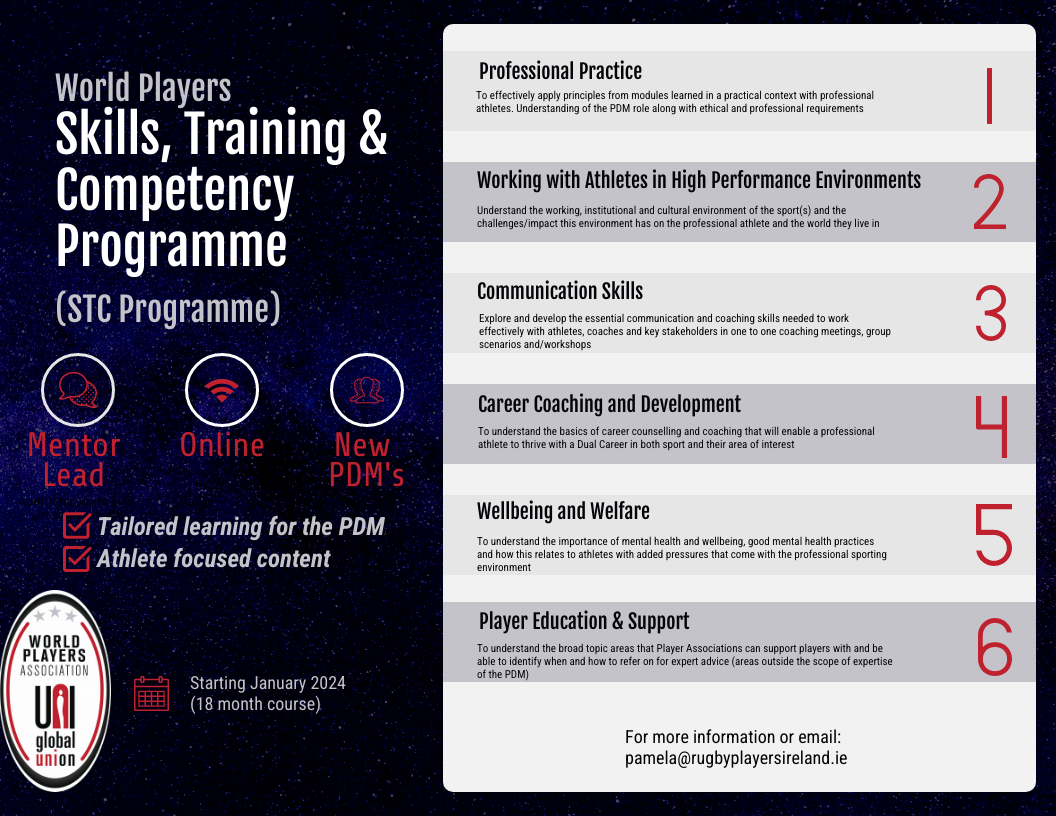
1. You should be currently working for a Player Association in a PDM role or similar.
2. Having a mentor is essential.
3. Candidates must be willing to undertake psychometric tests related to skills, values, working style preferences and provide pre and post course evaluations.
4. Your employer should be aware of this course and their role in the training (e.g. mentoring, role play, observations, feedback session, exposure to different environments).
Thank you!
Created with